AMETHIST supports maternal health researchers by offering expertise, resources, and coordination to sites through the NIH IMPROVE Initiative

The University of Pennsylvania (Penn) established the Achieving Maternal Empowerment and Transforming Health through Implementation Science and Training (AMETHIST@Penn) Implementation Science Hub to support the NIH IMPROVE initiative by strengthening care across pregnancy, childbirth, and the postpartum periods. AMETHIST supports the IMPROVE Maternal Health Research Centers of Excellence (CoEs), IMPROVE Community Implementation Programs (CIPs), and other IMPROVE investigators, and coordinates with NIH Staff Scientists, Project Staff, and the Data Innovation and Coordinating Hub
AMETHIST supports maternal health researchers by offering expertise, resources, and coordination to sites through the NIH IMPROVE Initiative
AMETHIST focuses on supporting the 12 IMPROVE Maternal Health Centers of Excellence and 4 Community Implementation Programs in centering patients and communities by providing care that reflects their lived experiences and needs throughout the research process.
Our hope is to strengthen the future maternal health research workforce by providing training, mentoring, and consultation. Through this work, AMETHIST will identify common challenges and successful strategies in maternal health implementation research, generating findings that can be applied across projects.
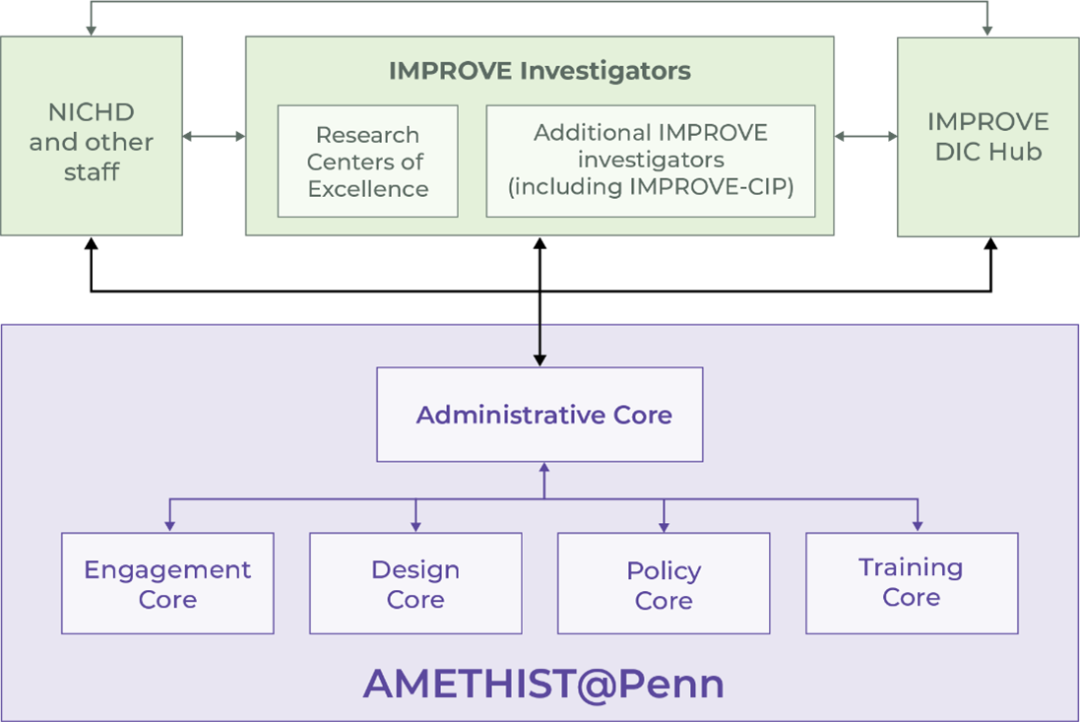
DIC: Data and Innovation Coordinating Hub; IMPROVE: Implementing Maternal Health and Pregnancy Outcomes Vision for Everyone; IMPROVE-CIP: Improve Community Implementation Program; NICHD: Eunice Kennedy Shriver National Institute of Child Health and Human Development; NIH: National Institutes of Health
Co-Directors/Core Leads: Meghan Lane-Fall, MD, MPH, MSHP; Rebecca Hamm, MD, MSCE; LauraEllen Ashcraft, PhD, MSW
Serves as the main point of contact between AMETHIST@Penn, CoEs and CIPs
Core Leads: Sarita Sonalkar, MD, MPH; Micki Burdick, PhD
Co-Investigators: Jaya Aysola, MD, MPH; Karen Glanz, PhD, MPH; Katelin Hoskins, PhD, MBE, CRNP; Elizabeth Howell, MD, MPP
Core Leads: Rebecca Hamm, MD, MSCE & LauraEllen Ashcraft, PhD, MSW
Co-Investigators: Shimrit Keddem, PhD, MPH; Consultant Panel; Postdoctoral fellow
Includes a Consultant Panel with Methods, Engagement, and Clinical subpanels to meet the anticipated consultation and technical assistance needs of the NIH IMPROVE Centers of Excellence (CoEs) and Community Implementation Programs (CIPs)
Core Leads: Aasta Mehta, MD, MPP & Man-pui Sally Chan, PhD
Co-Investigators: Debora Grandison, patient advocate; Jessica Fishman, PhD; Alice Abernathy, MD, MSHP; Sindhu Srinivas, MD, MSCE; Karl Stark
Policy and communication-related resources are available on our Resources page. Information about Policy Day will be posted on Events
Core Leads: Meghan Lane-Fall, MD, MPH, MSHP & Rebecca Clark, PhD, MSN, RN, CNM, WHNP-BC
Co-Investigators and Partners: Amanda Bettencourt, PhD, APRN, CCRN-K, ACCNS-P; Danielle Cullen, MD, MPH, MSHP; Penn REACH team
More information about AMETHIST training programs is available here

Core Leads:
Co-Investigators:
Core Leads:
Meghan Lane-Fall, MD, MPH, MSHP
Rebecca Clark, PhD, MSN, RN, CNM, WHNP-BC
Co-Investigators:
The larger AMETHIST family includes more than 50 investigators and staff members and multiple partnering centers at Penn. AMETHIST's network of consultants can provide tailored, individualized consultation for your specific project area of focus
Behavioral science
De-implementation
Implementation cost
Human centered design
Global health
Biostatistics
Qualitative & mixed methods
TMF, outcome, strategy selection
Implementation cost
BIPOC health
BIPOC youth
Community activism
Indigenous health
Rural health
Patient advocacy
Maternal health
Cardiovascular disease
Diabetes
Family planning
HIV/AIDS
Mental health
L&D/postpartum care
Substance use disorder
Diabetes
Lindsay Admon, MD, MSc (Engagement Enhancement Collaborative and consultant, rural health)
LauraEllen Ashcraft, PhD, MSW (co-investigator, Admin & Design cores)
Jaya Aysola, MD, DTMH, MPH (co-investigator, Engagement core)
Ellen Bass, PhD (consultant, systems engineering & human factors engineering)
Amanda Bettencourt, PhD, APRN, CCRN-K, ACCNS-P (co-investigator, Training core)
Mary Regina Boland, MA, MPhil, PhD (consultant, informatics)
Christopher Bonafide, MD, MSCE (de-implementation)
Man-pui Sally Chan, PhD (co-lead, Policy core)
Rebecca Clark, PhD, MSN, RN, CNM, WHNP-BC (co-lead, Training core)
Danielle Cullen, MD, MPH, MSHP (co-investigator, Training core)
Anuja Dokras, PhD, MD (consultant, women's health innovation)
Celeste Durnwald, MD (consultant, diabetes)
Nwadiogo Ejiogu, MD, MA (Engagement Enhancement Collaborative, reproductive justice)
Jessica Fishman, PhD (co-investigator, Policy core)
Natalie Fixmer-Oraiz, PhD (Engagement Enhancement Collaborative and consultant, LGBTQIA+ health)
Kristin Gerson, MD, PhD (consultant, preterm birth)
Karen Glanz, PhD (co-investigator, Engagement core and consultant, behavioral science)
Debora Grandison (co-investigator, Admin & Policy cores)
Rebecca Hamm, MD, MSCE (MPI and co-lead, Design core)
Heidi Harvie, MD, MBA, MSCE (consultant, implementation cost)
Adi Hirshberg, MD (consultant, hypertension)
Katelin Hoskins, PhD, MBE, CRNP (co-investigator, Engagement core)
Elizabeth Howell, MD, MPP (co-investigator, Admin & Engagement cores)
Abike James, MD, MPH (Engagement Enhancement Collaborative and consultant, BIPOC health)
Sara Kornfield, PhD (consultant, mental health)
Shimrit Keddem, PhD, MPH (co-investigator, Design core)
John Kimberly, PhD (consultant, management science)
Katy Backes Kozhimannil, PhD, MPA (Engagement Enhancement Collaborative and consultant, Indigenous health)
Meghan Lane-Fall, MD, MSCE, FCCM (MPI and co-lead, Training core and consultant, qualitative comparative analysis)
Insup Lee, PhD (consultant, biomedical engineering)
Kirstin Leitner, MD (consultant, postpartum care)
Mary Leonard, BA (graphic design)
Lisa Levine, MD, MSCE (consultant, labor and delivery)
Jennifer Lewey, MD, MPH (consultant, cardiovascular disease)
Aasta Mehta, MD, MPP (co-lead, Policy core)
Florence Momplaisir, MD, MSHP (consultant, HIV/AIDS)
Jennifer Myers, MD (consultant, quality improvement and patient safety)
Ingrid Nembhard, PhD (consultant, organizational behavior & teamwork)
Katharine Rendle, PhD, MPH (consultant, global health and cancer implementation)
Roy Rosin, MBA (consultant, healthcare innovation)
Courtney Schreiber, MD, MPH (co-investigator, Policy core)
Lindsey Shea, DrPH, MS (Engagement Enhancement Collaborative and consultant, disability health)
Sara Solomon, MPH, RD (Engagement Enhancement Collaborative and co-lead of REACH program)
Sarita Sonalkar, MD, MPH (co-lead, Engagement core)
Sindhu Srinivas, MD, MSCE (consultant, maternal health, policy)
Karl Stark (co-investigator, Policy core)
Alisa Stephens-Shields, PhD (co-lead, Design Core)
Robin Stevens, PhD, MPH (Engagement Enhancement Collaborative and consultant, BIPOC youth)
Nicole Thomas, MBA, CDP (Engagement Enhancement Collaborative and co-lead of REACH program)
Center for Evidence-Based Practice
Center for Health Incentives and Behavioral Economics
Center for Perioperative Outcomes Research and Transformation
Center for Research in Reproductive and Women's Health
FOCUS on Health and Leadership for Women
Funded by the National Institutes of Health, the Implementing a Maternal health and PRegnancy Outcomes Vision for Everyone (IMPROVE) Initiative launched in 2019 in response to high rates of pregnancy-related complications and deaths. The IMPROVE Initiative supports research to reduce preventable causes of maternal deaths and improve health for women before, during, and after pregnancy. It includes a special emphasis on health disparities and populations that are disproportionately affected. More information about IMPROVE can be found on the NIH site.
The 12 Maternal Health Research Centers of Excellence (CoEs) work to design and conduct research projects to address the biological, behavioral, environmental, socio-cultural, and structural factors that affect pregnancy-related complications and deaths. In addition to conducting research projects and building community partnerships, the Centers of Excellence support training and professional development, prioritizing early-stage investigators and those from backgrounds or identities currently underrepresented in the health sciences. More information about the CoE projects can be found on the Maternal Health Data Innovation and Coordination Hub website and at the center websites below:
Through the NIH Community Implementation Program (IMPROVE-CIP), community-engaged implementation research brings effective interventions into severely impacted communities. Learn more about IMPROVE-CIP here.